ADDADHD Checklist: A Practical Reference for Parents and Teachers (J-B Ed: Checklist) by Sandra F. Rief
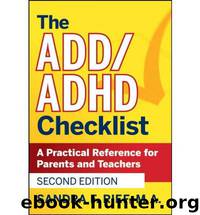
Author:Sandra F. Rief
Language: rus
Format: mobi
Publisher: Jossey Bass Wiley
Published: 2008-05-14T21:00:00+00:00
• For more on supports and considerations in creating a classroom
environment conducive to learning and behavioral and social success,
see checklists 3.1, 3.2, 3.7, 3.8, 3.9, and 3.10.
3.7 G ETTING AND FOCUSING
STUDENTS ’ ATTENTION
Before beginning instruction, teachers need to obtain students ’
attention and direct their focus to the task at hand. The following are
classroom strategies and techniques to do so.
Auditory Techniques
• Signal auditorily through the use of sound or music: chimes,
xylophone, playing a bar or chord on a keyboard, or a few seconds of
music on a CD.
c03.indd 136
6/16/08 9:45:10 AM
Checklists
for
Teachers
1 3 7
• There are various toys and noisemakers that make a novel sound
that may be an interesting auditory signal. Beepers or timers may also
be used.
• Use a clap pattern. You clap a particular pattern (for example, two
slow and three fast claps), and students repeat the clap pattern back
to you.
• Use a clear verbal signal: “ Popsicles . . . Freeze! ” or “ Everybody . . .
Ready, ” or “ 1, 2, 3, eyes on me ” ).
Visual Techniques
• Use visual signals such as fl ashing the lights or raising your hand,
which signals the students to raise their hands and stop talking until
everyone is silent and attentive.
• Teach specifi c hand signals such as American Sign Language to
signal students.
• Use pictures and other graphics, gestures, manipulatives, and other
interesting visuals to engage students ’ attention and interest. If using
a projector (overhead or document camera), placing a novel object or
colored shape that is shown on the screen is a visual attention getter.
• Use a dowel, stick, or other pointer or a laser pointer to point to
written material you want students to focus on.
• Use visual timers such as Time Timer ( www.timetimer.com ),
Time Tracker ( www.learningresources.com ), or Teach Timer ( www.
stokespublishing.com ).
• Cover or remove visual distractions. Erase unnecessary informa-
tion from the board, and remove visual clutter.
• Color is highly effective in getting attention. Use colored pens
and bold colors to write or frame important information. Use color
highlig
hting pens or tape and colored sticky notes. Write, circle, or
underline in color key words (particularly when giving directions).
The Tech Advantage
• Overhead projectors have traditionally been useful tools for focusing
students ’ attention in the classroom because they enable the teacher to:
• Model and frame important information
• Block unnecessary information by covering part of the
transparency
c03.indd 137
6/16/08 9:45:10 AM
1 3 8 SECTION
T H R E E
• Face students and not have to turn their back on the class in
order to write on the board
• Avoid instructional lag time while writing on the board and
erasing
• Prepare transparencies in advance, saving instructional time
• Project novel items such as math manipulatives
• Motivate students by allowing them to write on the overhead
or share their work with the class
• There are now far more engaging and sophisticated technologies
in classrooms, such as document cameras and interactive whiteboards.
Document cameras can project any object on the screen without the
need for making transparencies and enable students from all areas of
the classroom to see objects or teacher demonstrations clearly.
• PowerPoint presentations and other multimedia tools are enhanc-
ing instruction in many classrooms.
Download
This site does not store any files on its server. We only index and link to content provided by other sites. Please contact the content providers to delete copyright contents if any and email us, we'll remove relevant links or contents immediately.
Unwinding Anxiety by Judson Brewer(72961)
The Art of Coaching by Elena Aguilar(53141)
The Fast Metabolism Diet Cookbook by Haylie Pomroy(21119)
Rewire Your Anxious Brain by Catherine M. Pittman(18622)
Healthy Aging For Dummies by Brent Agin & Sharon Perkins RN(17029)
Talking to Strangers by Malcolm Gladwell(13332)
The Art of Thinking Clearly by Rolf Dobelli(10389)
Mindhunter: Inside the FBI's Elite Serial Crime Unit by John E. Douglas & Mark Olshaker(9299)
Crazy Rich Asians by Kevin Kwan(9262)
The Compound Effect by Darren Hardy(8908)
Tools of Titans by Timothy Ferriss(8347)
Periodization Training for Sports by Tudor Bompa(8237)
Becoming Supernatural by Dr. Joe Dispenza(8186)
Wonder by R. J. Palacio(8086)
Crystal Healing for Women by Mariah K. Lyons(7912)
Bodyweight Strength Training by Jay Cardiello(7894)
Change Your Questions, Change Your Life by Marilee Adams(7718)
Therapeutic Modalities for Musculoskeletal Injuries, 4E by Craig R. Denegar & Ethan Saliba & Susan Saliba(7706)
Nudge - Improving Decisions about Health, Wealth, and Happiness by Thaler Sunstein(7679)
